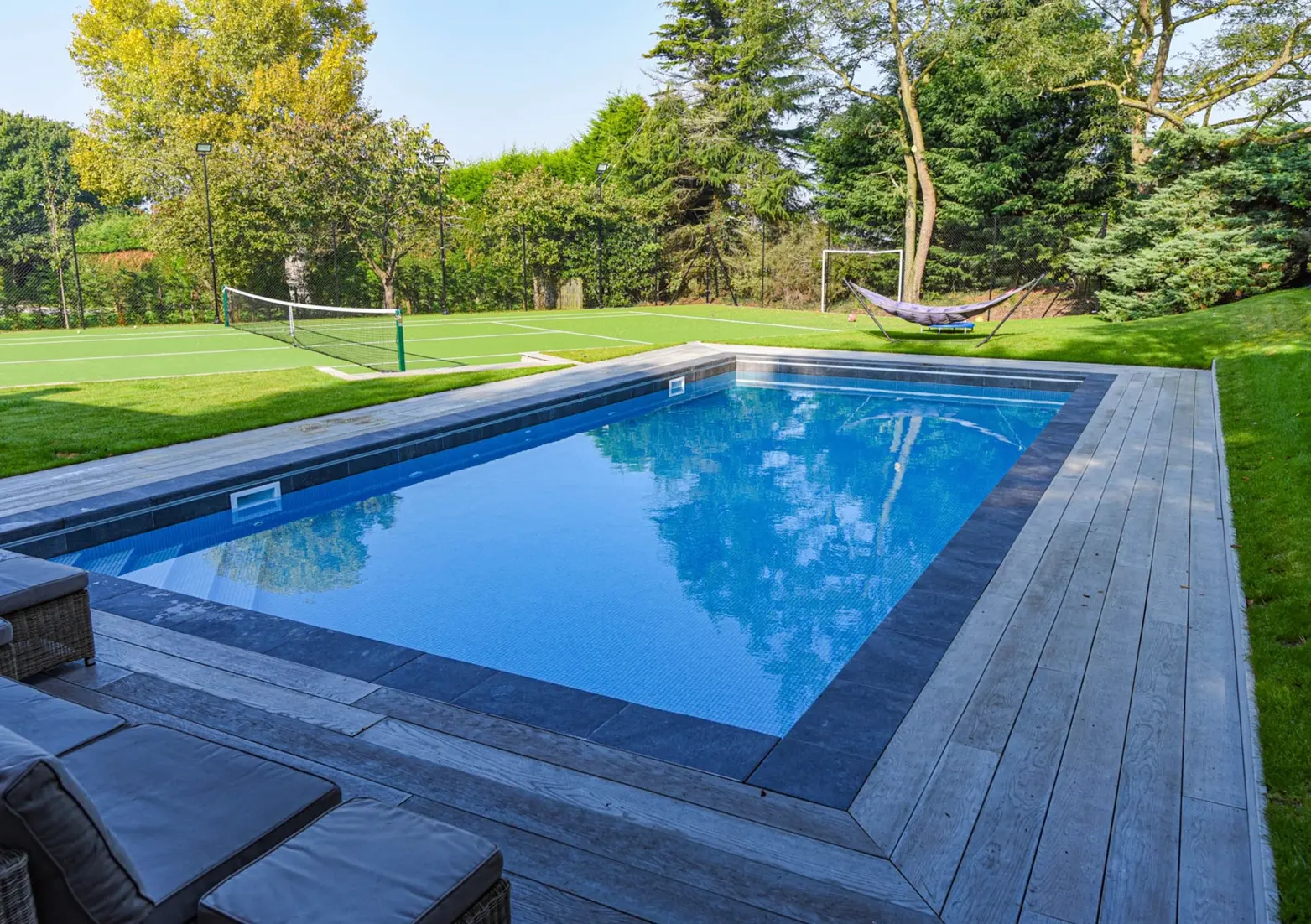
An infinity pool looks effortless: water spilling silently over an edge into nothing, as if the pool simply stops and the view begins. That effect is the result of careful engineering, not a lucky site. Get the details wrong and the edge looks uneven, noisy, or simply does not read as “infinity” at all.
This guide explains how vanishing-edge pools actually work, what UK sites and climates demand of the design, and what separates an infinity edge that performs beautifully from one that merely looks the part on the render.
How a Vanishing Edge Actually Works
The weir wall. An infinity edge is created by a weir wall set fractionally, typically just a few millimetres, below the main pool’s waterline. Water spills continuously over this wall into a catch basin concealed below, rather than the pool simply “ending”. Getting that weir wall level to within a few millimetres across its entire length is what determines whether the edge reads as a seamless sheet of water or an uneven one; our outdoor and infinity pools page has more on how we approach this stage.
The balance tank and pump return. Water that spills over the edge does not run to waste. It collects in a balance tank below the catch basin, from where it is filtered, treated and pumped back up to the main pool, maintaining a constant water level despite bathers, evaporation and wind. The size and location of this tank is one of the first engineering decisions made on any infinity project.
What UK Sites and Climate Demand
Structural gradient and ground conditions. Infinity pools are, by definition, built on a slope or a level change, whether that is a natural hillside, a terraced garden, or a raised deck over a basement. The structural shell has to be engineered for the specific ground conditions of the site, from stable bedrock to sloping or made-up ground that may need piling or retaining structures, before any water goes in.
Freeze-thaw resistance. In the UK, an exposed edge and catch basin sit through winters of repeated freezing and thawing. Materials, drainage details and insulation around the balance tank need to account for this, or the structure can crack over time; it is one of the more common failure points on poorly specified infinity installations.
Year-round heating and cover strategy. Because so much surface water is exposed at the edge, infinity pools lose heat faster than a conventional pool of the same size. A well-designed heating and cover strategy is factored in from the earliest design stage, not added once running costs turn out higher than expected.
Design Choices That Affect the Effect
Coping and edge detailing. The material and profile of the coping along the vanishing edge affects how the water sheets over it. Natural stone, porcelain and specialist infinity-edge profiles all behave differently, and the choice interacts directly with the weir wall design.
Backdrop and viewing angle. An infinity edge only reads as “infinity” from certain positions. Where the pool sits relative to the view, and where the majority of viewing will happen, from the house, a terrace, or the pool itself, shapes decisions about orientation and edge placement that are made during the design development stage of our process, long before construction starts.
FAQ
Can any garden have an infinity pool?
Not every site suits a vanishing edge. Infinity pools work best where there is a genuine change of level or view to exploit, whether that is a slope, a terrace, or an elevated position. A site visit early in the process establishes whether the design will earn its keep.
Do infinity pools cost more than a standard outdoor pool?
Generally, yes. The weir wall, balance tank and additional filtration plant add engineering and construction cost compared with a standard edge. Our swimming pool cost guide covers what drives the figure across pool types.
Are infinity pools harder to maintain?
The core maintenance, water treatment and filtration, is comparable to any pool. The main additional consideration is the balance tank and its pump, which need to be accessible for servicing and are usually included in an aftercare plan.
How long does an infinity pool take to build?
Timescales depend on the complexity of the groundworks as much as the pool itself. Our process page sets out the stages in detail, but a straightforward outdoor infinity pool is often a 12 to 16 week build once the design is approved.
The Bottom Line
An infinity pool is one of the most visually dramatic features a property can have, but the drama depends entirely on engineering most visitors will never see: a level weir wall, a properly sized balance tank, and a structural approach suited to the site. If you are considering a vanishing-edge design, our outdoor and infinity pools page explains how we approach these projects, or you can get in touch to discuss your site.


