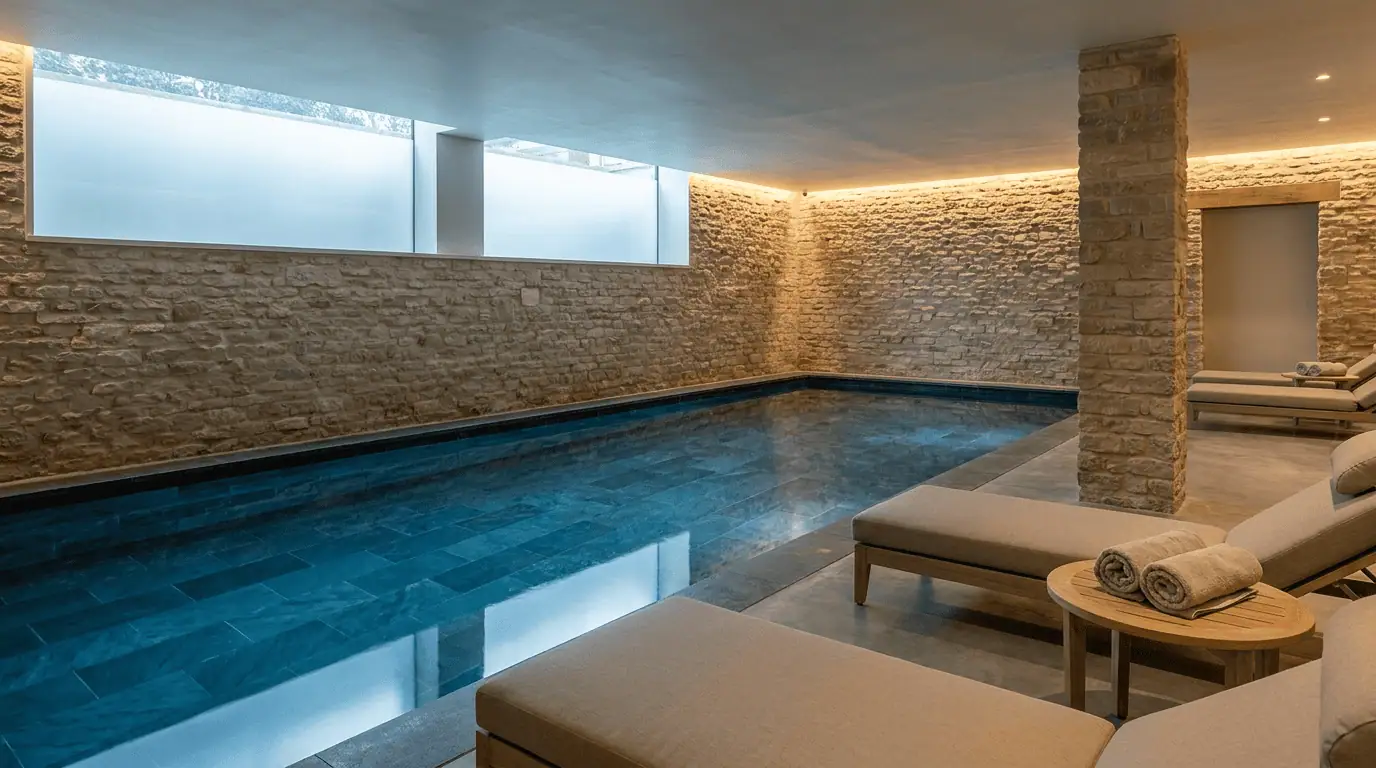
A basement swimming pool is entirely achievable in most UK homes, provided the project is treated as a structural engineering exercise first and an interior design project second. Converting or excavating a basement to hold a pool means managing tonnes of water inside a habitable building, so success rests on three disciplines: structure, waterproofing, and air handling. Get those right and a basement swimming pool becomes the most private, most usable pool you can own, swimmable every day of the year regardless of the British weather.
This guide explains what a basement pool conversion actually involves, the engineering realities most homeowners have not yet encountered, and how an experienced builder stages the work.
Why Build a Basement Swimming Pool?
For many of our clients the case is simple: a basement pool adds a year-round wellness space without sacrificing garden, and without the visual bulk of a new pool building. In conservation areas and on tight urban plots, going down is often the only way to add a pool at all, subject to planning policy in your area.
A basement scheme also concentrates everything in one controlled environment. Pool, spa, sauna, gym and plant can sit together on one level, with conditions managed precisely because the space is fully enclosed. Preston Pools designs and builds these environments as complete schemes; see our indoor swimming pool builders page for how indoor and basement projects are approached.
The Structural Realities
Water is heavy: a modest 10m x 4m pool holds tens of tonnes of water, all of it sitting within or beneath your home’s foundations. Three structural questions shape every basement swimming pool project.
Excavation and retention. Creating or deepening a basement means retaining the surrounding ground and, in terraced or semi-detached properties, protecting the neighbouring structures. Party wall agreements, underpinning and temporary works design are normal parts of the process, not warning signs.
The pool shell. A reinforced concrete shell, designed by a structural engineer for your specific ground conditions, is the standard for basement pools. It must resist both the water pushing out and, where the water table is high, groundwater pushing in.
Waterproofing. Basement pools are typically protected by multiple, independent waterproofing systems, so that no single barrier is ever the only thing keeping water where it belongs. This belt-and-braces approach is one of the clearest differences between a specialist pool builder and a general contractor.
Ventilation and Dehumidification: The Make-or-Break Systems
If structure is what keeps a basement pool safe, air handling is what keeps it pleasant. An indoor pool constantly evaporates water into the room, and in a sealed basement that moisture has nowhere to go unless plant is designed to remove it.
A properly engineered basement swimming pool includes a dedicated dehumidification and ventilation system that holds air temperature slightly above water temperature, controls humidity to protect the building fabric, and recovers heat from extracted air to reduce running costs. Undersized or domestic-grade kit is the most common failure we see in pools built without specialist input: condensation, corrosion and that heavy chlorine smell are symptoms of inadequate air handling, not inevitable features of indoor pools.
Plant space is the practical consequence. A basement pool scheme needs a dedicated plant room for filtration, heating, dehumidification and controls, and it needs to be planned in from the first drawing, not squeezed in at the end.
How a Basement Pool Conversion Is Staged
Bespoke basement projects follow a staged engineering process, and each stage de-risks the next.
Feasibility and survey. Ground investigation, water table assessment, structural survey of the existing building, and a realistic budget band.
Design and engineering. Architectural design, structural engineering, and mechanical and electrical design for water and air handling, coordinated as one package.
Consents. Planning permission where required, building regulations approval, and party wall agreements with neighbours.
Structural works. Excavation, retention, underpinning where needed, and casting of the waterproofed concrete shell.
Fit-out and commissioning. Finishes, pool plant, air handling installation, then water treatment balancing and full system commissioning before handover.
The same engineering-led approach underpins every pool we deliver as luxury swimming pool builders. It is why every basement scheme is designed and built to recognised UK construction standards, with the structural, mechanical and water-treatment work handled in-house rather than subcontracted, so quality is controlled at every stage.
What Does a Basement Swimming Pool Cost?
Basement pools are the most engineering-intensive pool type, and budgets reflect that. Costs vary widely with the scale of excavation, ground conditions and specification, so a meaningful figure only comes from a tailored quote. Excavation, retention and waterproofing carry much of the cost; the pool itself is a smaller share than most owners expect. For wellness-led briefs, hydrotherapy features can be integrated from the outset; our hydrotherapy pool page explains the options.
FAQ
Can you put a swimming pool in an existing basement?
Often, yes. An existing basement can sometimes be deepened or adapted to take a pool, subject to structural assessment, ground conditions and head height. Where no basement exists, a new excavation beneath or beside the house is the usual route.
Do I need planning permission for a basement swimming pool?
It depends on the property and the local authority. Internal works may fall under permitted development in some cases, but excavation, listed buildings and conservation areas usually require consent, so planning advice is part of any feasibility stage.
How long does a basement pool conversion take?
Timescales vary with scale and ground conditions, but owners should think in months rather than weeks, with design and consents preceding a structural and fit-out programme that commonly runs across a year or more for full excavations.
Are basement pools damp or smelly?
Not when properly engineered. Condensation and chlorine odour are signs of inadequate dehumidification and water treatment. A correctly specified air handling system keeps the space comfortable and protects the building fabric.
The Bottom Line
A basement swimming pool is a structural project that happens to hold water, and that is exactly how it should be designed: engineered shell, redundant waterproofing, and air handling sized for the space, delivered in clearly defined stages. Done properly, it is the most private and most used room in the house. To discuss whether your home can take a basement pool, start with our indoor and basement pools page or contact Preston Pools for a feasibility conversation.


